



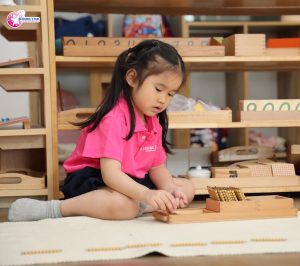

Nhiều phụ huynh khi ghé thăm lớp học Montessori 3-6 tuổi thường cảm thấy choáng ngợp trước hệ thống kệ giáo cụ đa dạng và đồ sộ.
Thực tế, sự đồ sộ này là một thiết lập khoa học để cụ thể hóa các khái niệm trừu tượng. Thay vì bắt não bộ trẻ phải tưởng tượng, Montessori chuyển hóa tri thức thành vật thể để trẻ trực tiếp cầm nắm và cảm nhận.
Trong Montessori, lớp học được phân chia theo các vùng chức năng: Thực hành cuộc sống, Cảm quan, Ngôn ngữ, Toán học và Văn hóa. Cấu trúc này giúp trẻ định vị không gian và làm chủ lộ trình khám phá của riêng mình.
Mọi giáo cụ đều tuân thủ nguyên tắc: Đi từ cụ thể đến trừu tượng. Đôi bàn tay là công cụ của trí tuệ loài người. Giáo cụ không phải để trưng bày, đó là phương tiện để trẻ tự xây dựng tư duy logic và ngôn ngữ một cách bản năng nhất. 

___________________________
IS MONTESSORI APPARATUS AS “COMPLEX” AS IT LOOKS? 

Many parents feel overwhelmed by the vast and diverse range of materials when first entering a Montessori 3–6 classroom.
In reality, this extensive system is a scientific setup designed to materialize abstract concepts. Instead of forcing a child’s brain to imagine, Montessori transforms knowledge into physical objects for direct handling and sensory perception.
At Shining Star, the classroom is strictly organized into functional areas: Practical Life, Sensorial, Language, Mathematics, and Culture. This structure helps children navigate the Prepared Environment and master their own learning path.
Every material follows the ultimate principle: From the concrete to the abstract.
“The hands are the instruments of man’s intelligence,” as Maria Montessori once said. These materials are not for display; they are the essential means for children to instinctively build their logical thinking and language.
___________________________
TRƯỜNG MẦM NON SHINING STAR TỐ HỮU
 Địa chỉ: Roman Plaza, 69 Tố Hữu, Hà Đông, Hà Nội
 Hotline: 096.581.1919 hoặc 024.3202.9119 Website: shining-star.edu.vn